

Principle: Always Be Prepared
The Boy Scouts have it right.
As coaches, a big part of our role is preparation. We build a game plan. We communicate that plan clearly. And we rehearse it all week so our players know exactly what’s expected when matchday arrives.
Preparation creates confidence leading to reduced hesitation.
And hesitation is often the difference between winning and losing.
But preparation doesn’t stop with what we hope will happen.
Perspective: Risk Management
Sometimes coaches become so focused on their plan that they forget how many variables exist once the game actually starts.
Weather changes.
Crowds influence emotion.
Players arrive with different mindsets.
Opponents adapt.
The best coaches don’t leave these variables to chance.
They think through what could go wrong, and more importantly, how they and their team will respond when it does. Preparation, at the highest level, is about risk management.
It’s easy to dismiss thinking about failure, but planning for these dark scenarios is actually the highest form of optimism, as it ensures your success is resilient.
It’s about reducing surprise, so when disruption arrives, it doesn’t create panic.
Story: Bill Walsh’s “War Gaming”
Bill Walsh, shares this helpful illustration in “The Score Takes Care of Itself”.
“The local fire department was called in to help rescue a cat stuck up in a tall tree. After a couple of hours, they got the cat down from the tree. During all the congratulations afterward, the fire truck drove off and ran over the cat. Despite their hard work, they had no plan for what to do after the cat was rescued.”
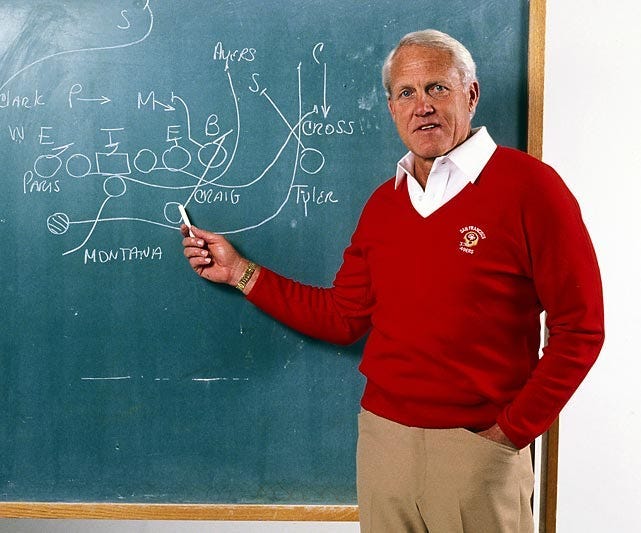
Before every game as head coach of the San Francisco 49ers, Bill Walsh asked himself one question again and again:
“What do I do if…?”
Contingency planning — or what Walsh called “war gaming” — was central to his Standard of Performance. He didn’t just plan for success. He planned for disruption.
Walsh meticulously worked through scenarios like:
What if we fall behind by two touchdowns in the first quarter?
What if the offense sputters in the second half?
What if key players are injured?
What if we’re protecting a late lead?
How do we communicate in hostile environments?
How do tactics change with wind or heavy rain?
Nothing was left to improvisation under stress. By mentally rehearsing these high-stress situations, the emotional intensity of the actual event is dramatically reduced. The brain shifts from panic mode to recall mode, executing a plan it already owns.
By preparing for multiple outcomes, Walsh gave his players clarity and calm, no matter what the game threw at them. They didn’t need to panic. They had already been there in their minds.
Question
How can you encourage a “war gaming” mindset within your players and staff?
Closing Thought
Great coaching is about being ready for the future, whatever happens.
Preparation isn’t just planning for success; it is the preventative measure that keeps chaos from taking control of your team’s performance when the game is on the line.
Until next week,
Caleb Cousens